 ZeeHub
AI logistics planning agent for manufacturersLoads, carriers, paperwork.
Planned around cost and deadlines.
ZeeHub’s logistics agent plans every load around your priorities: cost, deadlines and available fleet. When the day changes, it acts: it spots the border delay, re-plans the affected loads, proposes the best carrier and route, prepares the shipping paperwork, and asks your team to approve. One click, and the plan is updated.
a year saved in logistics costs at a multi-plant co-packer.
saved per truckload.
| Load | Route | Pallets | Carrier | Status |
|---|---|---|---|---|
| L-1001 | Plant A to Cust. 1 | 26 | Carrier A | Planned |
| L-1002 | Plant A to Cust. 2 | 22 | Carrier B | Planned |
| L-1003 | Plant B to Cust. 3, cross-border | 24 | Carrier C | Paperwork ready |
| L-1004 | Plant B to Cust. 4 | 18 | Carrier A | Needs approval |
| L-1005 | Plant C to Cust. 5 | 30 | None yet | Carrier needed |
When the day changes
- Detects the change
- Re-plans the loads
- Proposes carrier and route
- Prepares paperwork
- Your team approves
Metrics we move
- On-time delivery
- Cost per load
- Dock utilization
- Empty miles and waiting
See the logistics agent in action
Watch: how the logistics agent plans and re-plans your deliveries (1 min 23 sec).

Read the video transcript
Every day, your team plans and schedules dozens of deliveries. Each one depends on the right truck, the right route, and the right timing.
But the day rarely goes exactly as planned. A truck gets held up, a customer needs a rush delivery, or you’re short on staff. Sometimes, it all happens at once.
Your team scrambles to rebuild the schedule. Then something else changes… and the cycle starts again.
Is there a better way to handle all this chaos?
Meet ZeeHub, your AI logistics planning agent.
It tracks trucks, flags delays, and compares alternative routes, border crossing times, and available capacity to recommend an updated plan.
Your priorities guide that plan: lower costs, critical deadlines, or better use of your fleet. Your team reviews and approves changes with one click.
Dock preparation and delivery documents stay connected, so everyone works from the latest plan.
When holiday demand surges or capacity drops, ZeeHub helps you adapt.
One manufacturer saves between one hundred and fifty and two hundred dollars per truckload.
ZeeHub works with your ERP and carriers, and goes live in weeks.
Your team spends less time chasing updates, and more time keeping deliveries moving.
ZeeHub. Smarter planning, from first pickup to final delivery.
Book a demo at zeehub.ai.
Inside the logistics planning screen
Actual ZeeHub product captures from the Northfield Demo workspace, captured November 5, 2026. Names, loads, dates and dollar amounts shown here are demo data.
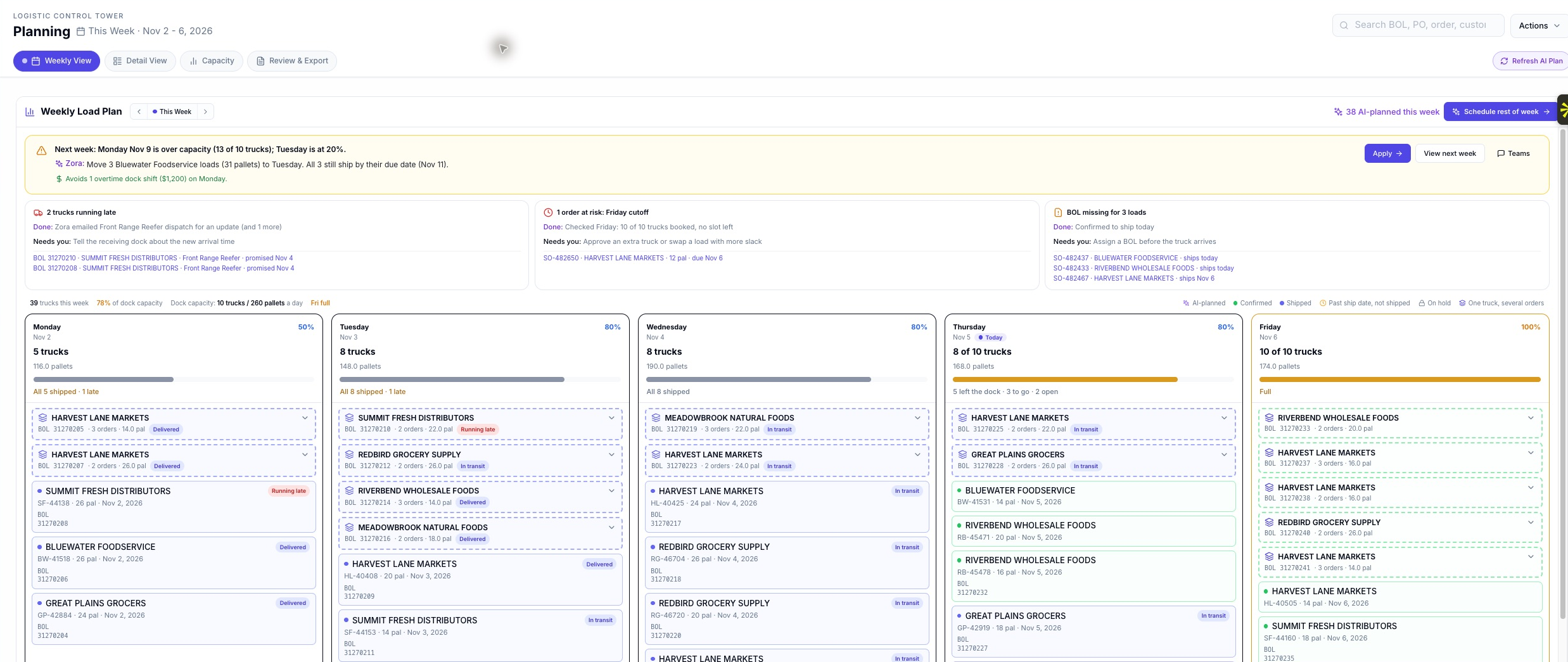
What the recommendation says
Move three Bluewater Foodservice demo loads, totaling 31 pallets, to Tuesday. The recommendation states that all three still ship by their November 11 due date and estimates avoiding one $1,200 overtime dock shift on Monday.
The planner can review the proposed change before selecting Apply. This capture shows the recommendation before application; it does not show a completed approval or a realized saving.
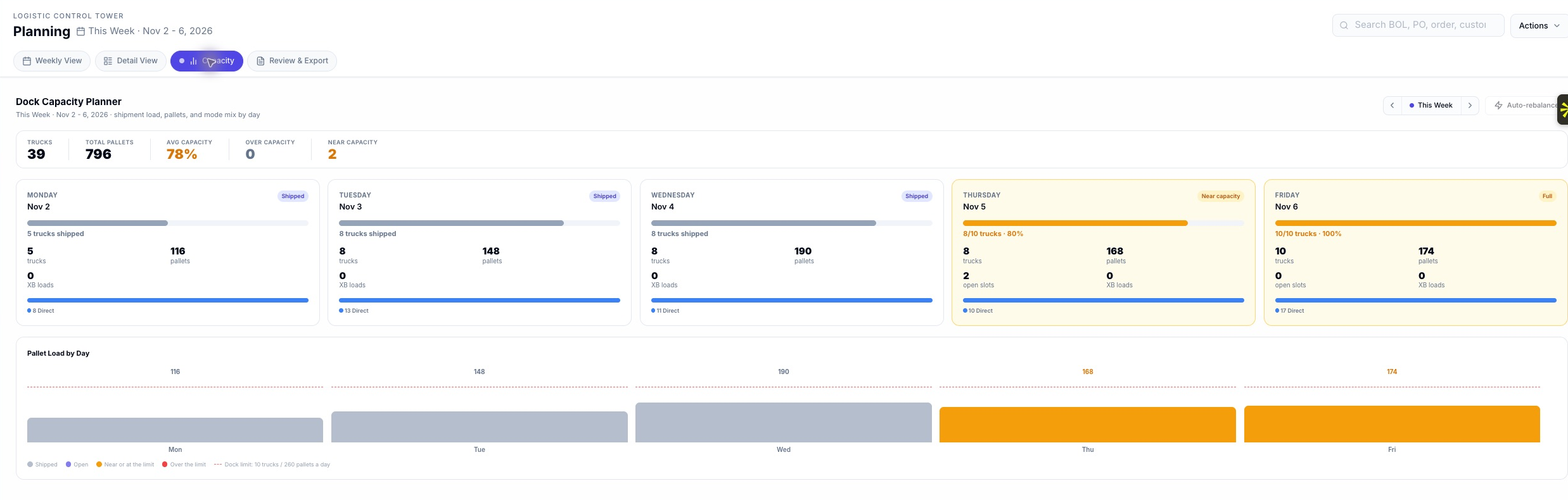
Open either image for the full-size view. These captures demonstrate the planning interface. Customer outcome figures are described separately in the logistics case study.
What the logistics agent does
It plans the work a logistics team does every week, around cost and deadlines.
- Loads and pallets
- Plans loads and pallets around cost and deadlines.
- Carriers
- Plans which carrier takes each load, with cost and deadlines in view.
- Cross-border timing
- Plans the timing of loads that cross a border.
- Shipping paperwork
- Produces the shipping paperwork for every load.
How it works, and who stays in control
Routine work runs on its own. A person approves anything that carries a cost or a customer.
| Runs on its own | Waits for a person to approve |
|---|---|
| Routine work, within the rules you set | Anything with a cost attached |
| Every action logged | Anything with a customer attached |
Our rule on every deployment.
It reads first
Agents connect to your ERP, spreadsheets and inboxes without replacing any of them.
You set what it may do
You decide the rules before anything runs.
Routine work runs on its own
Anything with a cost or a customer attached waits for a person to approve.
Every action is logged
Who or what changed a plan, sent an email or filed a document, and when.
Proof from a multi-plant co-packer
saved in logistics costs at a multi-plant co-packer with plants in the US and Mexico
Company name withheld under NDA.
Read the case studySee your savings per truckload
Send us last month’s loads (a spreadsheet export is fine). Within 3 business days we’ll show where ZeeHub would have saved cost per truckload, which loads were at risk, and how much dock and fleet capacity you left unused. Free, no commitment.
Fits the way you already work
The agent reads your data where it lives. Nothing is replaced.
Connects to your systems
SAP, Oracle, NetSuite, Microsoft Dynamics, Epicor, Sage, SharePoint, Excel and CSV, and email.
Built for manufacturers
Food, consumer and packaging manufacturers with $100M to $2B in revenue.
Secure by design
Hosted on Microsoft Azure in the United States. Access is through a read-only service account that you issue. Read the security details.
Logistics agent questions
What is an AI logistics planning agent?
An AI logistics planning agent uses shipment, carrier and capacity data to recommend and update delivery plans. ZeeHub plans loads, pallets, routes and cross-border timing around cost, deadlines and available fleet. When a delay changes the day, it compares alternatives, prepares shipping paperwork and asks your team to approve changes.
Does it replace our ERP?
No. ZeeHub agents connect to your ERP, spreadsheets and inboxes without replacing any of them.
How does ZeeHub handle border delays, rush orders or a fleet shortage?
ZeeHub tracks trucks, flags delays and compares alternative routes, border crossing times and available capacity. It recommends an updated plan based on your priorities: lower costs, critical deadlines or fleet use. When holiday demand surges or capacity drops, your team reviews and approves changes while dock preparation and delivery documents stay connected.
Who approves what?
You set what the agent may do. Routine work runs on its own. Anything with a cost or a customer attached waits for a person to approve.
What result have you seen?
At a multi-plant co-packer with plants in the US and Mexico, the logistics agent saved $600K a year in logistics costs. That is recurring annual savings. A manufacturer saves $150 to $200 per truckload. The company name is withheld under NDA, and reference calls are available on request.
What is the free savings assessment?
Send us last month’s loads (a spreadsheet export is fine). Within 3 business days we show where ZeeHub would have saved cost per truckload, which loads were at risk, and how much dock and fleet capacity went unused. It is free, with no commitment.
How does an engagement start?
With a six-week pilot: one workflow, one site, with the success metric agreed in writing before kickoff.
Where is our data hosted, and who can see it?
Customer data is hosted on Microsoft Azure in the United States and is never used to train AI models. Only the named ZeeHub engineers on a deployment can see that customer’s data. Details are on the security page.
Want the same result in your plant?
Pick one problem. We scope a six-week pilot around a number we agree on first.
Discuss your use caseOr email hello@zeehub.ai
- One workflow, one site
- Success metric agreed in writing before kickoff
- A six-week pilot