 ZeeHub

Oregon SB 582
Fees live. 2027 fees are invoiced in two halves, January and July.
ZeeHub emails your packaging suppliers, follows up on missing specs, checks replies against source documents, and prepares your packaging data for reporting. Suppliers respond by email without creating an account.
For U.S. brands with 50 or more packaging suppliers. No chasing.
Sent within 2 business days.
2027: California starts. Oregon and Colorado are already billing.
Same tray, about seven times the fee: 34 cents vs 5 cents per pound in Oregon, 2027 rates.
| Supplier | Component | Docs | Status |
|---|---|---|---|
| Northfield Films | Lid film | 13/13 | Matches spec |
| Cascade Board Co. | Tray | 11/13 | Recycled content missing |
| Prairie Corrugated | Shipper case | 13/13 | Matches spec |
| Summit Print | Sleeve | 9/13 | Reminded, day 3 |
| Delta Closures | Cap | 13/13 | Matches spec |
| Ridgeway Labels | Label | 12/13 | Spec sheet expired |
ZeeHub emails suppliers for missing documents, sends reminders and moves missed deadlines to a phone-call queue. Then follow one weight discrepancy from the supplier's spec to a reviewed update, with the source evidence kept.
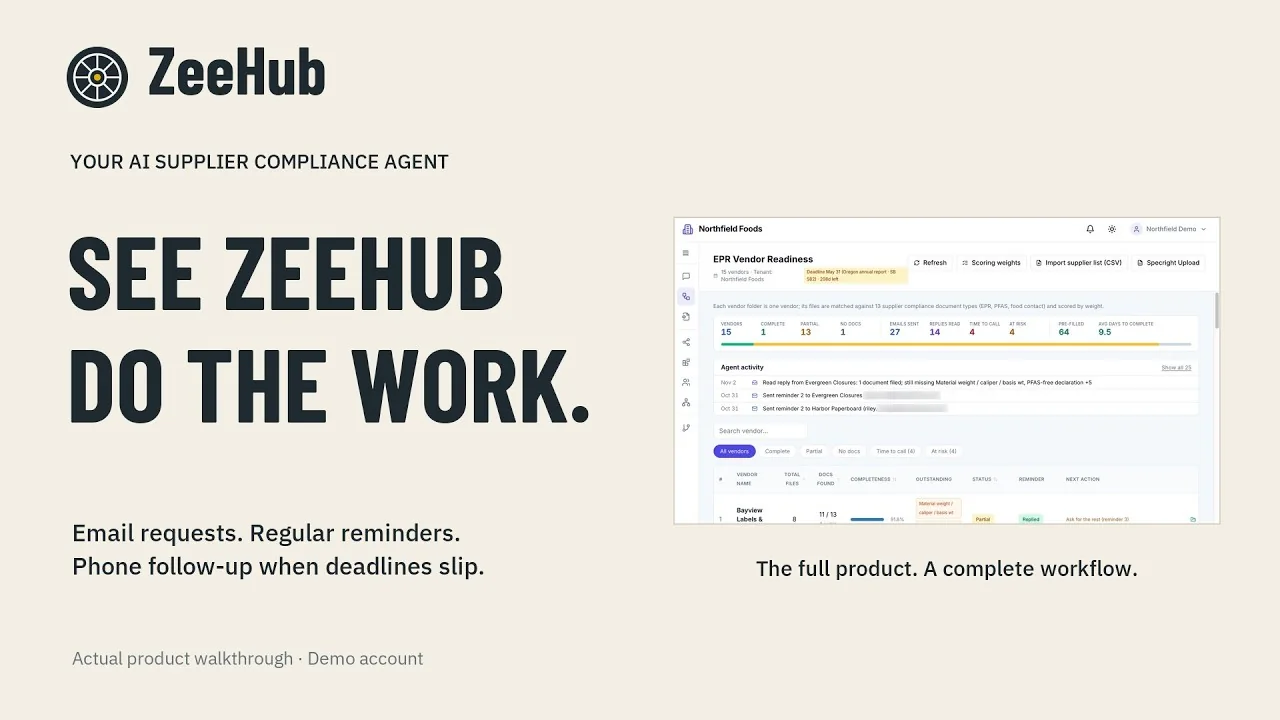
Edited replay of demo-account screens with sample data.
| Task | Who handles it |
|---|---|
| Collects supplier data | ZeeHub. It emails each packaging supplier, follows up on missing specs and takes replies by email. Suppliers do not create an account. |
| Validates the data | ZeeHub. It checks replies against source documents and flags gaps and mismatches. |
| Handles unresolved exceptions | Your team. Suppliers who need a phone call, disputed values and any gap that email does not close. ZeeHub surfaces each one with its evidence. |
| Prepares each report | ZeeHub. It prepares your packaging data for reporting, in the format your PRO or consultant needs. |
| Enters each report | Your authorized representative. Your team or your consultant. |
| Approves each report | Your team. A reviewer approves each proposed data update, and your authorized representative approves the report. |
| Submits each report | Your authorized representative. |
ZeeHub does not provide legal advice.
Illustrative example. It follows the product demonstration above and uses demo-account data. It is not a customer result.
Subject: Please confirm closure weight: 3.8 g or 4.1 g?
Our record for this closure lists 3.8 g. Your revised specification (Revision C) lists 4.1 g. Please confirm which weight is correct and attach the current specification.
Watch the discrepancy at 0:21 · Watch the review at 0:43
For a real deployment, read the published food manufacturer case study: live in six weeks across 100+ packaging suppliers, with 2,000+ documents collected to date.
EPR makes brands pay to recycle the packaging they sell. Seven US states have passed it.
Pick the states you sell into.
Dots mark when fees start. 2026 reports were due May 31; 2027 dates are expected to be similar. Confirm with CAA. Obligations and exemptions vary by state and producer. Reviewed on November 8, 2026. Sources
Fees live. 2027 fees are invoiced in two halves, January and July.
Fees live. Next invoice January 2027.
Program starts by January 1, 2027.
Early fees for 2027 published October 1, 2026. Invoice date not yet announced.
Simplified reports yearly. Cost reimbursement starts July 1, 2028; fees may start earlier.
Simplified reports yearly. Fees start February 2029.
No reporting deadline yet.
Pick at least one state above to see its next deadline.
One guide per state: what the law asks of brands, where the deadlines stand, and which supplier data to collect.
Producers had to register by May 31, 2026 (June 1, since May 31 fell on a Sunday). 2025 supply and source reduction reports were due to CAA the same day.
Read the California guideProgram live since July 2025. Fees are being invoiced.
Read the Oregon guideProgram live since January 2026. Fees are being invoiced.
Read the Colorado guidePRO membership was due July 1, 2026. An early 2027 fee schedule is published.
Read the Washington guideRegistration was due May 31, 2026. Cost reimbursement starts July 1, 2028.
Read the Maryland guidePRO membership was due July 1, 2025. Cost-share funding is expected from 2029.
Read the Minnesota guideStewardship organization not yet contracted. Timing is under review.
Read the Maine guidepackaging suppliers at one mid-size food manufacturer.
Your item master knows what you sell; your suppliers know what it’s made of. But specs go out of date, weights get rounded, and recycled content goes unreported.
Under Oregon’s 2027 fee schedule, polycoated paperboard costs 34¢ per pound and plain paperboard costs 5¢. Same tray, same weight, about seven times the fee. Only your supplier’s spec sheet says which one you have.
The lower rate applies only when the packaging actually qualifies. The real risk runs both ways: guess wrong and you overpay, or under-report.
| Task | Spreadsheets | Consultant | ZeeHub |
|---|---|---|---|
| Chasing suppliers | Your team, by hand | Usually still your team | Automatic requests and follow-ups |
| Checking data | When someone has time | At filing time | Every document, as it arrives |
| Proof for an audit | Email threads | Their working files | Every number links to its source |
| What it costs | Hidden staff hours | Hourly or per filing | One subscription |
Starting from the spreadsheets and spec files you already have.
| Material | Components | Weight (lb) | Source docs | Status |
|---|---|---|---|---|
| PET/PE film | 38 | 18,420 | 38 of 38 | Ready |
| Coated paperboard | 51 | 96,310 | 49 of 51 | 2 pending |
| Corrugated | 44 | 212,880 | 44 of 44 | Ready |
| PP closures | 12 | 6,145 | 12 of 12 | Ready |
| Paper labels | 29 | 4,960 | 27 of 29 | 1 expired |
Illustrative figures. Every weight links to its source document.
Download a sample export (CSV). Illustrative data. We export in the format your PRO or filer needs.
Find the components and suppliers behind every SKU.
ZeeHub emails and follows up. Your team only steps in when a supplier needs a phone call.
Current, complete, matches your spec? Gaps are flagged with the reason, not just a red cell.
Ready for your PRO report and fee estimate.
Expiring specs and new SKUs trigger new requests, so next year starts clean, not with a fresh scramble.
The same agent handles other supplier documents, from PFAS declarations to certificates.
Feeds Specright or any spec platform.
Your advisor gets clean, sourced data.
Collect once, reuse for every state.
Company name withheld per NDA. Details available on request. This is one customer deployment.
Read the EPR customer case studyCollect supplier data once and reuse it for every requirement.
Weights, materials and recycled content for state reports.
RoHS, REACH, PFAS, Prop 65 and heavy-metal declarations from your suppliers. Live for electronics. Regulation pack for food and consumer packaging. See the Restricted Substances page
Food-contact statements, letters of guarantee, allergen declarations and quality certificates. Available on request.
Packaging EPR software helps brands collect and organize the packaging data needed for extended producer responsibility reporting. ZeeHub maps SKUs to packaging components, requests specs from suppliers, follows up on missing information, checks documents and exports source-linked data for your PRO or filer. Your team reviews exceptions. ZeeHub does not provide legal advice; your team approves and submits reports.
Your authorized representative submits each report. We prepare it ready to submit, in the format your PRO or consultant needs.
ZeeHub collects and validates the supplier data and prepares your packaging data for reporting. Your team handles unresolved exceptions. Your authorized representative enters, approves and submits each report.
No. ZeeHub works alongside your ERP, spreadsheets and spec platform, including Specright. It collects and checks supplier evidence and prepares component-level exports. Your consultant remains responsible for interpreting your obligations, and your authorized representative submits each report.
One US food manufacturer went live in six weeks across 100+ packaging suppliers, with 2,000+ documents collected to date and 13 document types checked per supplier. Scope and timing depend on your data and workflow. Read the customer case study.
If your brand is on packaged products sold into an EPR state, probably yes. Without a US brand owner, it’s usually the importer.
Yes, based on revenue or tonnage. Thresholds differ by state.
Each SKU’s packaging components, with material, weight and units sold per state. Some states also want recycled content.
ZeeHub exports component-level data: material, coatings, weight, recycled content and units by state, each linked to its source document. We export in the format your PRO or filer needs. See a sample export (CSV), illustrative data.
Both are multiplied together, but material usually matters more. In Oregon, the same 38 g tray costs about seven times more under 2027 rates if it’s plastic-coated paperboard instead of plain paperboard. Getting the exact material from the supplier is the biggest lever. The lower rate applies only when the packaging actually qualifies. The real risk runs both ways: guess wrong and you overpay, or under-report.
Supplier data collection is live for all seven US states with packaging EPR laws; reporting timelines vary by state. Restricted Substances (RoHS, REACH, PFAS, Prop 65): Live for electronics. Regulation pack for food and consumer packaging. Food-Contact & Safety documents are a regulation pack, available on request. All run on the same supplier engine.
California can fine up to $50,000 per day per violation, starting 30 days after a notice.
Customer data is hosted on Microsoft Azure in the United States. It is encrypted in transit (TLS 1.2 or higher) and at rest (AES-256). Agents connect through read-only credentials your team issues and can revoke at any time, only the named ZeeHub engineers on your deployment can see your data, and every action is logged. Customer data is never used to train AI models. SOC 2 Type I is in progress, with a target of Q1 2027. Read the security details.
You can export your data while your contract is active and for 30 days after it ends. We delete it within 30 days of the contract ending and confirm the deletion in writing on request. You can also cut off access at any time by disabling the credentials you issued.
Primary sources for every deadline and penalty on this page. State dates reviewed on November 8, 2026. General information, not legal advice.
Get a free EPR gap report: which states you owe reports in, which supplier documents you’re likely missing, and how much of your data is ready. We send it within 2 business days.
Prefer email? hello@zeehub.ai