By Shekhar Nirkhe, Co-Founder & CTO
The question haunting every C-suite meeting lately is simple: How do we beat the 2027 SAP sunset without breaking the business?
The migration from Enterprise Central Component (ECC) to SAP S/4HANA is the single largest architectural reckoning in modern enterprise history. It requires deconstructing decades of complex, customized business logic and refactoring it for a radically different columnar database architecture. It’s a $100 billion global "forced march" where missing the finish line triggers extortionate penalty fees that can gut an IT budget overnight. Traditional System Integrators (SIs) will tell you this takes two years and a small village of consultants. We disagree. We built ZeeHub because manual "archeology" through millions of lines of code is a legacy solution to a modern crisis.
timeline
    2025 : The Panic Begins
         : SIs quote 18-24 month timelines
    2026 : The Talent Squeeze
         : Available ABAP/HANA migration experts vanish
    Dec 31, 2027 : The Deadline
         : SAP ECC Mainstream Maintenance Ends
         : Premium Maintenance Fees Kick In
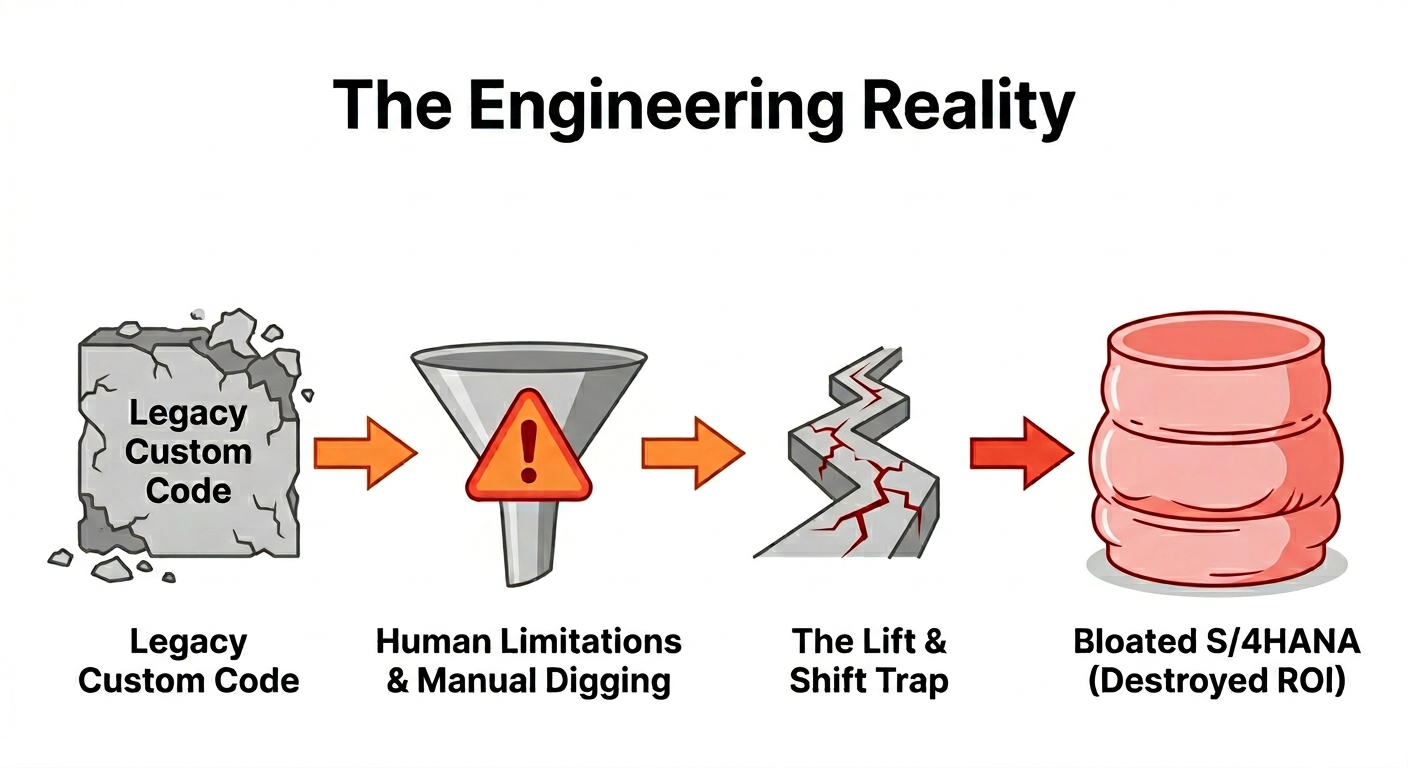
When I look at the architecture of these delayed projects, the bottleneck isn't the new database—it's the sheer volume of technical debt colliding with manual processes.
An enterprise SAP system isn't just pristine standard code. Under the hood, it’s a massive legacy monolith filled with thousands of custom Advanced Business Application Programming (ABAP) Z-programs, undocumented user exits, and procedural logic built by teams who moved on long ago.
Here is why the traditional System Integrator (SI) playbook bleeds time and money:
The result? Enterprises spend 18+ months and tens of millions of dollars just to run the exact same bloated code on an expensive new database.
While competitors treat migration as a translation problem—swapping old syntax for new—Zeehub treats it as a semantic equivalence problem. Our Abstract Syntax Tree (AST)-Symbolic Hybrid Engine doesn't just read text; it parses the structural intent of your custom ABAP. By cross-referencing your legacy code against a live, vector-indexed graph of every SAP Note and Simplification List update since 2010, we don't just refactor code; we reconstruct your business logic for the in-memory era. This isn't just automation; it's a deterministic, mathematically verified evolution of your enterprise core.
Instead of consultants spending months reading code, our proprietary architecture executes autonomously across three core vectors:
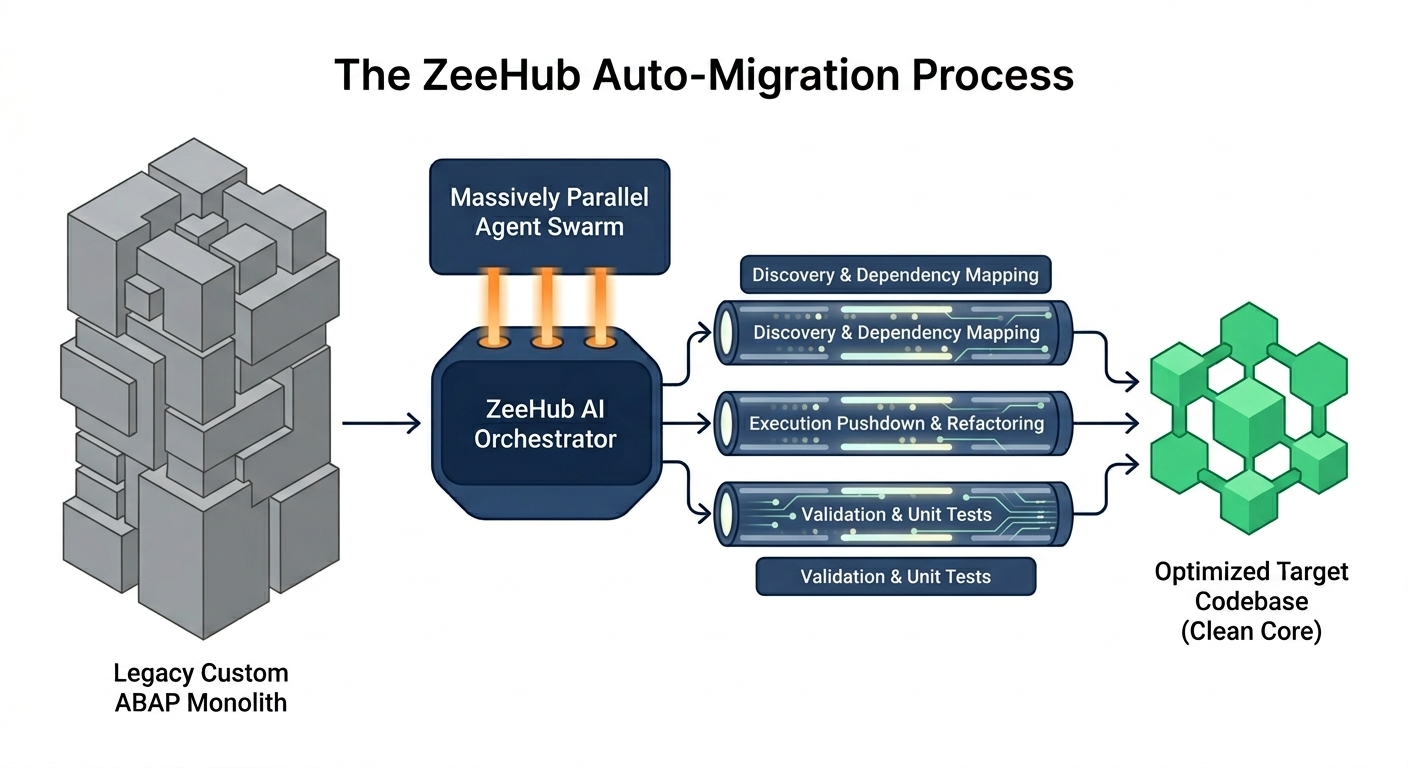
VBAK), our agents automatically trace the dependency graph through Delivery (LIKP) and Billing (VBRK) to ensure a change in pricing logic doesn't break downstream revenue recognition. This deep semantic understanding guarantees that replacing deprecated tables like MSEG never shatters your manufacturing supply chain visibility.FOR ALL ENTRIES patterns or migrating logic entirely to CDS views. Your code isn't just ported; it's reborn to process data at true in-memory speeds.We know the biggest barrier to enterprise adoption is fear. That’s why we don't just dive in with a vague estimation—we run a Complexity Compression Scan before you sign a contract.
We generate a definitive ZeeHub Readiness Score. We tell you: "Your system has 50,000 custom objects. Our AST-Symbolic engine predicts we can fully automate 92% of them. The remaining 8% require human intervention." We put a hard guarantee on the timeline based on deterministic data, not a sales pitch.
The 2027 deadline isn't just about software—it's a hard limit on global execution capacity. Elite SAP developer rates are skyrocketing while the available talent pool evaporates.
You can either pay for an army of consultants to manually reinvent the wheel over two treacherous years, or you can leverage ZeeHub's AST-Symbolic Hybrid Engine to deterministically reconstruct your core in months. The choice for your balance sheet is mathematical, and the clock is ticking.